
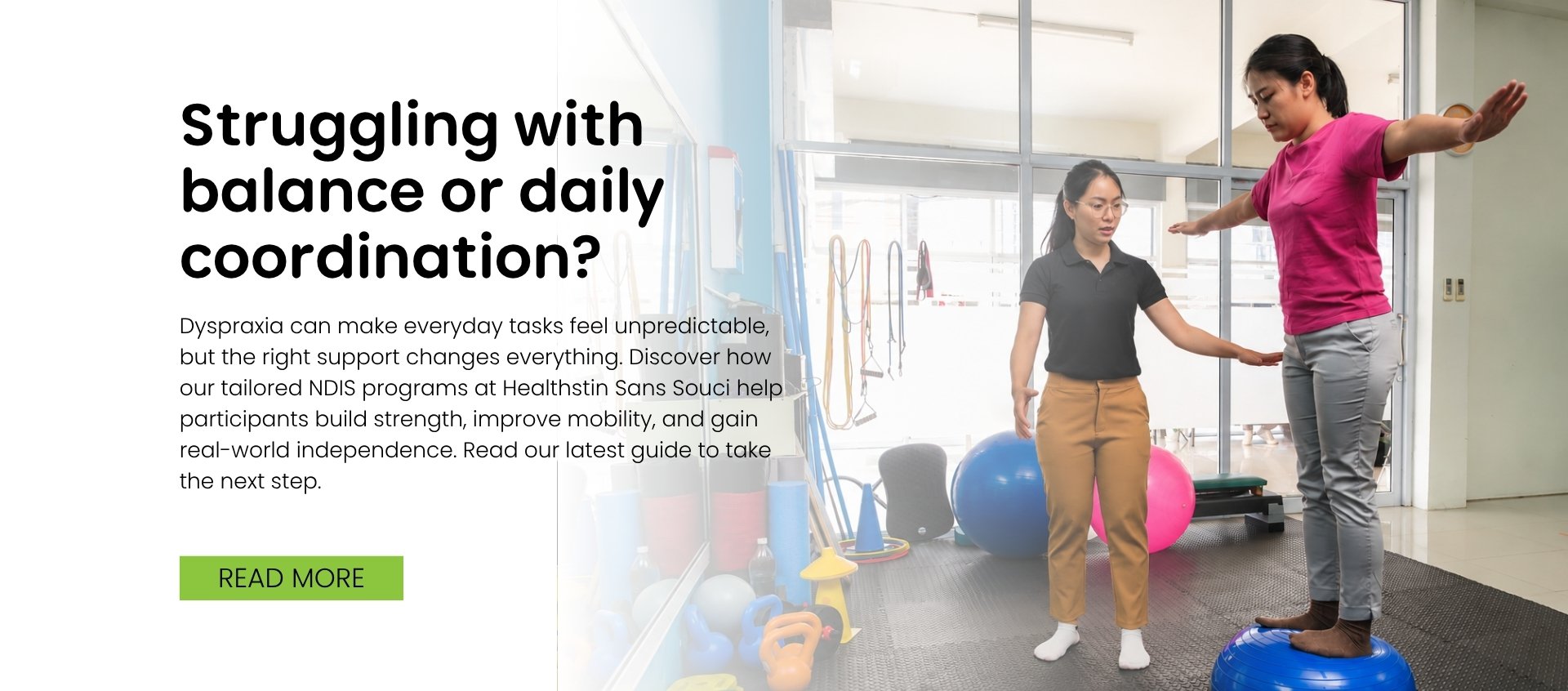
Living with dyspraxia can make everyday things (like getting around or tackling chores) feel frustratingly tricky. For NDIS participants, having the right local support is key to building confidence and moving through life with ease. At Healthstin Sans Souci, our team works closely with you to tackle these hurdles with practical, hands-on care tailored to your goals.
Understanding Dyspraxia and Its Impact on Daily Life
Dyspraxia is a neurological condition that affects motor skill development. Unlike conditions characterised by muscle weakness, dyspraxia is primarily an issue of motor planning. The brain struggles to properly plan, sequence, and execute coordinated physical movements. This can affect both gross motor skills (such as walking, running, and maintaining posture) and fine motor skills, which involve precise hand-eye coordination like writing, buttoning a shirt, or using utensils.
Everyday outings can feel a bit unpredictable when you have dyspraxia. Simple things like catching a bus, walking on uneven pavement, or cooking a meal take a surprising amount of balance, coordination, and physical effort. Without the right guidance, it is easy to end up feeling worn out, frustrated, or hesitant to get out and about.
That is where tailored NDIS dyspraxia support in Sans Souci comes in. It is designed to bridge that gap, giving you a clear, structured path to move through your day with greater confidence and independence.
The Role of Dyspraxia Physiotherapy in Movement and Stability
Physiotherapy forms a cornerstone of physical support for participants with motor planning difficulties. Dyspraxia physiotherapy goes beyond traditional strength training by focusing heavily on proprioception (the body's ability to sense its position in space) and vestibular function, which governs balance.
When you start working with a practitioner at Healthstin Sans Souci, the first step is a friendly, thorough assessment to see how you move. We look at everyday things like your balance when moving around, how steady your core is, and how you walk.
From there, we team up to build a custom support plan just for you, packed with practical balance and coordination exercises that make a real difference in your daily routine. These exercises might include:
- Single-leg stance variations to challenge balance and ankle stability.
- Dual-task activities that require the participant to perform a physical movement while engaging in a cognitive task, mimicking real-world scenarios.
- Simple drills using resistance bands or stability balls help your body better sense where your limbs are and how they are moving.
By practising these movements regularly in a relaxed, supportive setting, you help your body move more smoothly and naturally, making everyday balance and posture feel much easier.
Gross Motor Skills Therapy: Building Strength and Spatial Awareness
If dyspraxia affects your large movements, you might notice things like feeling a bit clumsy, misjudging space around you, or having an uneven walking style. Gross motor skills therapy focuses on your big muscle groups (like your legs, core, and arms) to help you move more smoothly, build up your stamina, and feel totally steady on your feet.
At Healthstin clinic, gross motor interventions are structured to be engaging and directly applicable to daily life. Practitioners use a variety of practical methods to challenge and improve large-muscle coordination:
Agility ladders and obstacle courses to improve footwork, timing, and directional changes. Core stabilisation routines that provide a solid foundation for arm and leg movements, helping reduce the likelihood of trips and falls.
Bilateral coordination tasks that require both sides of the body to work together in a synchronised rhythm, such as skipping or coordinated throwing and catching drills.
These targeted activities help participants feel more secure in their physical movements, reducing anxiety around physical exertion, and encouraging greater participation in community and recreational activities.
Fine Motor Skills Therapy: Enhancing Precision and Independence
Fine motor sessions utilise clinical, task-oriented training to support dexterity and hand-eye coordination. Practitioners may incorporate:
Hand-strengthening tools and resistance exercises to build endurance in the intrinsic muscles of the hand.
Practising simple handling exercises with different textures helps your hands better gauge pressure and grip things just right.
By breaking complex manual tasks down into manageable steps, participants learn effective strategies to overcome motor planning blocks, boosting their self-reliance in daily routines.
Functional Movement Training: Bridging Support and Real-World Application
Ultimately, the goal of any support plan is to translate clinic practice into real-world capability. This is where functional movement training becomes invaluable. Rather than isolating individual muscle groups, functional movement focuses on multi-joint, purposeful movements that mirror daily activities (such as lifting, reaching, bending, and stepping).
For NDIS participants, this means focusing on the exact movements needed for your personal goals (like safely carrying groceries, getting in and out of a car on your own, or playing your favorite sport). By practicing these everyday movements in a comfortable, guided setting, you build the muscle memory and confidence to do them smoothly out in the real world.
A Collaborative, Participant-Centric Approach at Healthstin
Figuring out the NDIS can sometimes feel a bit complicated, but getting the right health support should be easy. Our team works closely with you, your family, and your support coordinators to make sure your plan matches your personal NDIS goals every step of the way.
Whether an individual is looking to improve their physical stability, enhance their manual dexterity, or gain greater confidence in navigating public spaces, our clinic provides a welcoming environment dedicated to functional progress. Through a blend of targeted physical interventions, practical skill-building, and consistent encouragement, participants are empowered to take an active role in their physical well-being.
To learn more about how our tailored programs can support your goals or the goals of a participant in your care, reach out to our team at Healthstin to discuss a customised pathway forward.
Contact Healthstin Today
Ready to take back your independence and move through life on your own terms? The friendly, registered NDIS team at Healthstin is here to help. We bring hands-on, active therapy straight to you whether that is in your own home or out in the Sans Souci community. Call 1300 090 931 to talk with us and take the first step toward a more manageable, balanced routine. Or click on the link below:
No-Obligation Free Consultation | Healthstin Allied Health
Disclaimer: The information provided in this article is for educational and informational purposes only and is not intended as a substitute for professional medical, physical therapy, or allied health advice, diagnosis, or treatment. Always seek the advice of your qualified healthcare provider with any questions you may have regarding a medical condition or therapy plan.