
Long-term reduced mobility changes a body gradually, often so slowly that it's easy to miss until a joint feels noticeably harder to move than it used to. Whether someone uses a wheelchair, has had an extended hospital stay, or lives with a progressive neurological condition, the muscles and soft tissue around a joint can shorten over time and lose some of their natural give. For many participants, family carers and support coordinators, this shows up as stiff joints that take more effort to move through their full range each day. It's a common part of living with long-term immobility, and one a physiotherapist can help address through range-of-motion physiotherapy as part of everyday care.
This kind of stiffness has a clinical name: a contracture, which develops when the muscles, tendons or other soft tissue around a joint shorten and resist being moved through their usual range. Contractures are common wherever movement has been limited for an extended period, including after a spinal cord injury, with cerebral palsy or multiple sclerosis, or following a long hospital admission. They affect a substantial number of Australians: the Australian Institute of Health and Welfare's most recent disability report found that 25% of people with disability living in households needed assistance with mobility, one of the most common support needs identified. At Healthstin Sans Souci, our physiotherapists work alongside participants and their care teams to help keep joints moving as well as they safely can, as one part of a broader plan.
What Happens to Joints During Long-Term Immobility?
When a joint isn't moved through its full range regularly, the muscles and tendons around it gradually adapt to that shorter position. Over weeks and months, soft tissue can lose some of its natural elasticity, making the joint feel tighter and the surrounding muscles more resistant to movement. This can affect anyone who spends long periods without full movement, but it's particularly relevant for people living with a spinal cord injury, cerebral palsy, multiple sclerosis, an acquired brain injury, or those recovering from an extended hospital stay. The change isn't about anyone doing something wrong. It's a physical response to reduced movement over time, which is why ongoing physiotherapy input is often included in a longer-term care plan for people with these conditions.
How Can Gentle Range-of-Motion Physiotherapy Help?
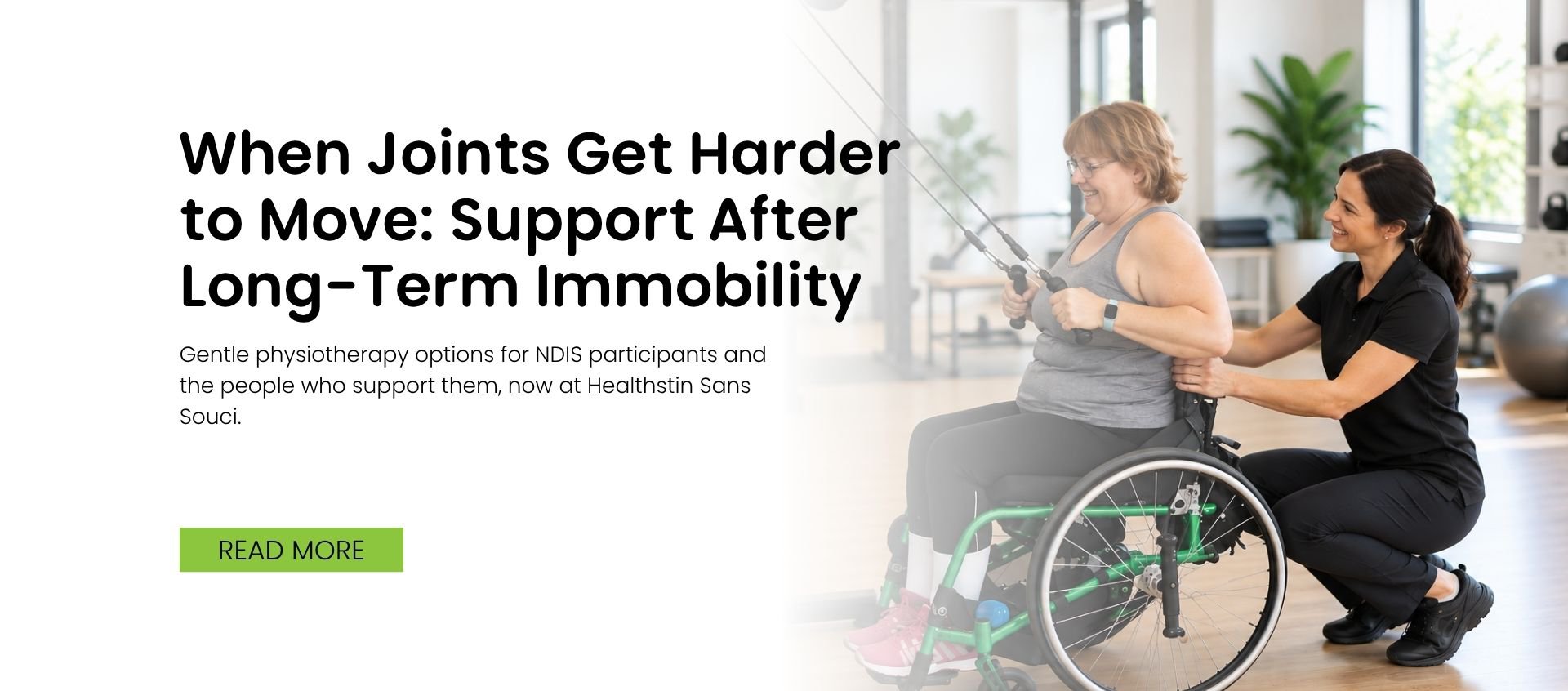
A physiotherapist can work with a participant to gently move a joint through its available range, either guiding the movement directly (passive movement) or supporting some effort from the person themselves (active-assisted movement). This is usually paired with positioning advice for everyday activities such as sitting, lying and transfers, along with a home program a family member or carer can help continue between sessions.
It's worth being upfront about the evidence here. A well-known Cochrane systematic review examined stretch-based interventions for contractures in people with neurological conditions and found they did not produce a clinically important improvement in joint mobility on their own, in the short term. That doesn't make this kind of physiotherapy pointless. It's exactly why physiotherapists tend to combine gentle range-of-motion work with positioning, an individualised plan and regular review, rather than relying on stretching alone. Results vary between individuals, and a physiotherapist can help set realistic, personal goals rather than promise a particular outcome.
What this can involve:
- Passive or active-assisted movement of affected joints
- Positioning advice for sitting, lying and daily transfers
- A home program tailored to the person's goals and abilities
- Regular review to adjust the plan as circumstances change
If you're supporting someone with long-term immobility and aren't sure where to start, our team offers a free 30-minute NDIS consultation to talk through goals and options. Call 1300 090 931 or book online. There's no obligation and no cost.
A Team Approach for NDIS Participants
Physiotherapists lead range-of-motion and positioning work, but they're rarely the only professional involved in supporting someone with long-term immobility. Exercise physiologists can build broader strength, endurance and movement programs around a person's goals, and at our Sans Souci clinic, hydrotherapy is also available in our on-site pool, where the warmth and buoyancy of water can make gentle joint movement more comfortable for some participants. Keeping these roles clear matters: a physiotherapist manages the clinical reasoning behind joint mobility and positioning, while exercise physiology and hydrotherapy support the broader strength and movement side of a plan.
Physiotherapy for reduced mobility can often be funded under NDIS Capacity Building supports, depending on the goals set out in a participant's plan. Support is available inclinic, through mobile home visits across the Sans Souci and Sutherland Shire areas, or via telehealth for those who can't easily get to the clinic.
Finding the Right NDIS Physiotherapy Provider in Sans Souci
If you're a support coordinator, GP or family member looking for physiotherapy Sans Souci services for someone managing long-term immobility, a few questions can help narrow the search. Does the provider understand contracture risk in neurological and disability-related conditions, not just general aged-care stiffness? Do they communicate clearly with the rest of the care team? Is the program built around the person's own goals rather than a standard template? And can they explain, in plain terms, how a service fits within an NDIS plan?
Our Sans Souci clinic operates inside the Sans Souci Leisure Centre, with in-clinic, mobile and telehealth options available for participants across the area. Long-term immobility doesn't have to mean giving up on joint movement altogether. Gentle, physiotherapist-led range-of-motion work, alongside positioning advice and a plan built around a person's own goals, is one sensible part of managing contracture risk over time. It tends to work best as part of a coordinated approach, alongside exercise physiology, hydrotherapy or other supports where relevant, rather than as a stand-alone fix.
Ready to talk through a referral? Support coordinators, GPs and family members can submit a referral online, or call 1300 090 931 to speak with our Sans Souci team directly.